And Why Your Clients May Blame You After the Fact If It’s Not Done Right
A weak Wi-Fi signal could be considered a construction flaw that luxury homebuyers will talk about at every dinner party. Modern estates run on a massive ecosystem of smart lighting, multi-room audio, 4K/8K streaming, security cameras, home theaters, and remote work demands. But what makes it all work is often the last thing builders and home buyers think about: the network infrastructure.
The hard truth is that if you wait until drywall is up to think about Wi-Fi, you’re already behind schedule and over budget. Worse, your client will be the one living with the problem.
By integrating network strategy early, you protect your schedule, your bottom line, and your reputation as a builder who delivers luxury that actually works from day one. Learn more below.
SEE ALSO: High-End Tech Integration as a Design Differentiator in MDUs
Avoid These Top 3 Costly Change Orders
Builders care most about staying on schedule and on budget. Poor network planning creates expensive, preventable problems that surface at the worst possible time. We’ve seen the following problems, and what actually ends up happening when they arise:
- Dead Wi-Fi zones discovered during final walkthrough: Cables need to be fished through finished walls, causing costly change orders, delayed closeout, and angry clients
- Missing conduit or low-voltage boxes: Electricians have to cut drywall, patch, and repaint, slowing down the whole build process
- Client complaints about lagging smart home network after move-in: They blame the builder’s luxury finish quality, not the $200 router from the Big Box Store
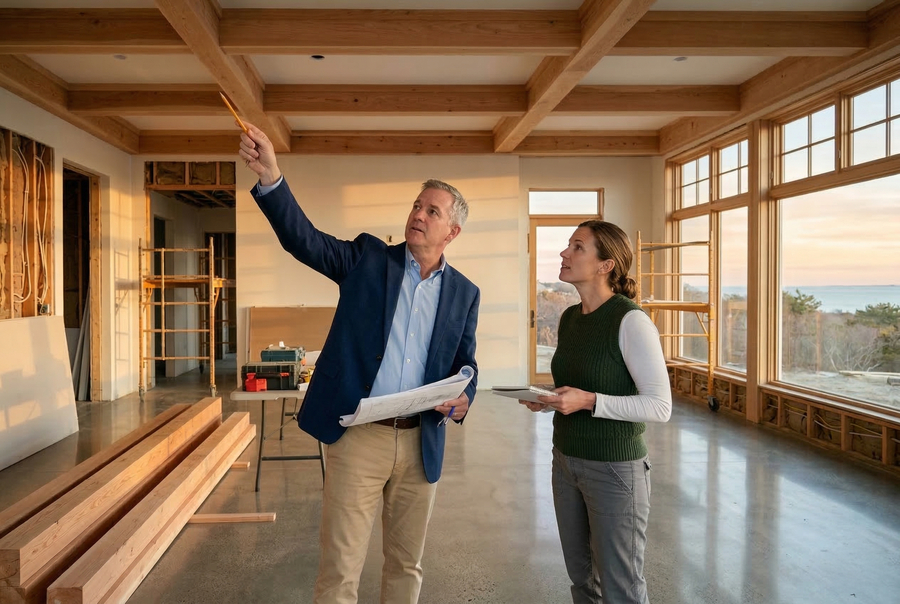
Early network design prevents late change orders that delay your punch list. When we map out access points, cable drops, and equipment locations during the architectural phase, the home performs flawlessly from day one without surprises. And you won’t receive emergency calls three months after closeout.
Industry Standards Matter & Impress Clientele
Luxury homes need infrastructure that goes far beyond retail-grade routers and consumer Wi-Fi extenders. To deliver that level of luxury, network designs must meet the ANSI/TIA-570-D residential cabling standard.
Citing objective industry codes gives your blueprints immediate credibility with clients and subcontractors. A robust, builder-approved network architecture needs three non-negotiable elements:
1. Star-Wired Topology
Every single cable drop runs directly back to a central location instead of being daisy-chained. By doing this, we can ensure maximum bandwidth and the ability to upgrade individual rooms without affecting the whole system in the future.
2. Centralized Distribution Closet
A dedicated space with proper ventilation, climate control, and dedicated power circuits to house the network rack, switches, audio/video processors, and smart home controllers. This is the heart of the home’s technology.
3. Cat6/Cat6A and Dedicated Conduit
Premium cabling handles today’s high-speed data, while conduit lets you upgrade decades from now without cutting walls. We’ve upgraded homes where clients later wanted 10GbE, and those with conduit were easy. Those without? They required demolition.
Overcome Networking Interference
Larger luxury homes use dense building materials, such as concrete, steel, radiant floor heating, and low-emission glass. These materials block wireless signals like a Faraday cage. Enterprise-grade networking isn’t optional for these larger, technology-rich properties. It’s the only way to align the digital infrastructure with the home's physical craftsmanship.
We’re Your Technology Partner, Not Your Competitor
We know builders sometimes resist outside experts who seem to disrupt established workflows. Let’s be clear: we’re not here to criticize your process. We’re here to make your life easier.
When you bring a certified AV and network integrator into the fold early, well before framing or electrical bids, you gain a dedicated technology design partner and consultant who:
- Provides precise layouts, interference maps, and equipment specifications
- Runs cables efficiently the first time
- Coordinates directly with your electrician for the lighting design and install portion of the system design
We run the cables, but you’ll still manage the subs. We just make sure the right cables end up in the right places so nothing fails after closeout.
Book a Project Consultation Today
Your clients didn’t spend millions on a custom home to struggle with spotty Wi-Fi. Let’s make sure the network infrastructure is as polished as the granite countertops and imported tile. Contact us to schedule a technology design consultation for your next custom build.